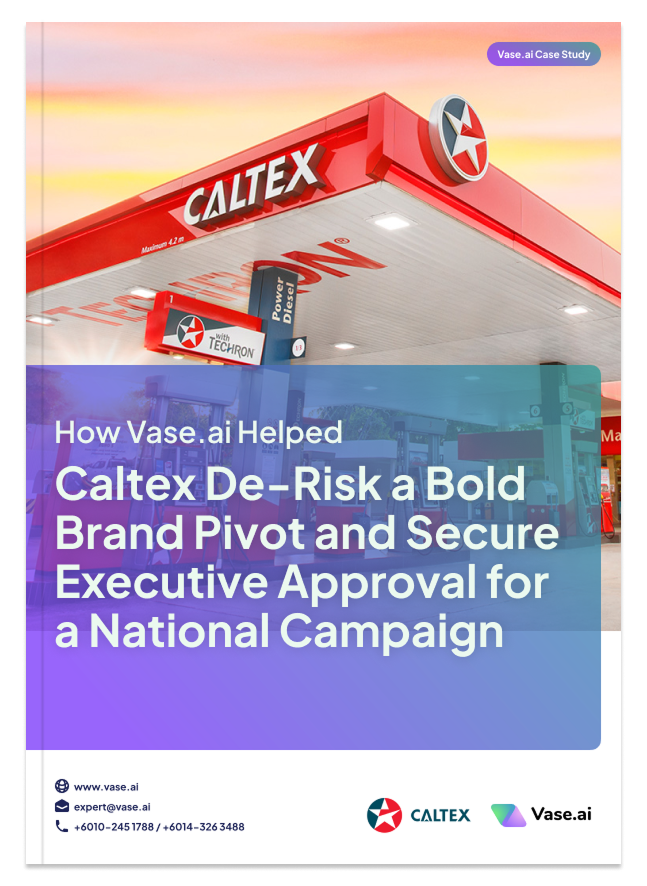
How Vase.ai Helped Caltex De-Risk a Bold Brand Pivot and Secure Executive Approval for a National Campaign
The Challenge
Caltex found itself at a critical juncture in the Malaysian market. Relevance was slipping, market share was eroding, and the brand was struggling to connect emotionally with modern motorists. To reverse this, TBWA\Kuala Lumpur proposed a radical departure from category norms: shifting the brand from selling a commodity (fuel and performance) to selling an emotion (“Driving Happiness”).
The Stakes Were High
Moving away from traditional pump-price messaging was a massive creative gamble. If the pivot failed, the consequences would have been damaging:
Misallocation of multi-million ringgit marketing budgets on a message that might alienate the core customer base.
Operational gridlock due to a lack of internal stakeholder buy-in for a "radical" idea.
Market share erosion if the new emotional positioning failed to drive actual purchase intent.
The Struggle
While TBWA believed in the "Drives Happiness" strategy, they faced significant internal skepticism. Bold moves require rock-solid evidence to win over a boardroom. Caltex needed to know, with 100% certainty, if this emotional territory was:
Authentic: Did it feel believable coming from a fuel brand?
Relevant: Would it actually rebuild brand relevance for Malaysian drivers?
Ownable: Could Caltex credibly own "Happiness" long-term?
Without reliable data, the team was stuck between playing it safe with "boring" ads or taking a reckless leap of faith.
Why Vase.ai
TBWA partnered with Vase.ai because they needed independent, high-speed validation that could translate creative vision into the "hard numbers" required for executive approval.
The Vase.ai Solution
Vase.ai designed a targeted research framework to put the "Driving Happiness" concept to the ultimate test:
Research Framework
Use Case: Concept Testing & Brand Positioning Validation.
Methodology: Mixed-method study (Quantitative metrics + Qualitative feedback).
Timeline: Delivered in weeks to align with TBWA's campaign launch schedule.
Sample: A representative cross-section of Malaysian motorists.
The Vase.ai Advantage
Vase.ai’s superpower is Strategic Independent Validation. By providing a neutral, data-backed perspective, Vase.ai allowed the agency to reframe a "creative risk" as a statistically validated opportunity, removing the emotional bias from the decision-making process.
The Results
The research provided the "green light" the team needed through high-impact metrics:
81% Memorability: The concept was found to be highly memorable, far exceeding traditional fuel category benchmarks.
63% Personal Relevance: Proving the "Happiness" shift spoke directly to the personal needs of motorists.
80% Intent to Act: Consumers indicated they would research, share, or purchase from Caltex after exposure.
Conversion Potential: A meaningful cohort of non-loyal drivers indicated a shift toward purchase intent after seeing the concept.
Business Impact
Armed with these insights, TBWA and Caltex were able to:
Secure Executive Buy-In: Hard data turned internal skepticism into unanimous approval for the brand pivot.
Safe Transformation: Caltex launched its refreshed brand direction with the confidence that the message would perform.
Market Growth: Early tracking showed immediate upticks in brand consideration and emotional resonance.
The total impact: Transformed a risky brand pivot into a safe, strategic transformation that protected Caltex's market position while revitalizing its emotional core.
Testimonials
How brands uses Vase.ai for better research
"When the stakes are high, bold doesn’t have to mean reckless. By pairing TBWA’s creative vision with Vase.ai’s independent validation, Caltex executed a dramatic pivot responsibly, proving that research isn’t merely supportive—it’s strategic."
TBWA\Kuala Lumpur
(Strategic Partner for Caltex)
Caltex’s story demonstrates how brand erosion can be stopped by de-risking bold creative ideas. By leveraging Vase.ai’s concept testing, they transformed a "radical" departure into a confident, data-backed market success in just weeks.
Case Study
Download our latest case study by filling up this form!