
Quick answer: For most Indonesia FMCG tests, a survey platform with a verified consumer panel is the fastest way to compare packs, claims, flavour concepts and price points among real category buyers. Full-service agencies suit complex or in-home product tests, while sample marketplaces suit teams with their own analysts. Choose based on the test type, the regions you must read and how quickly the decision is due.
Indonesian FMCG teams run a steady stream of small, decision-focused tests. Which pack design stands out on a crowded minimarket shelf? Which claim is most believable to mothers? Which new flavour deserves a production run? These are narrower than a full concept test, and the right platform depends on the test type.
This guide looks at four common FMCG test types and the platform options that suit each, with practical design notes for Indonesian shoppers.
Which platform types are available for FMCG tests in Indonesia?
| Platform type | Examples | Strengths for FMCG tests | Considerations |
|---|---|---|---|
| Survey platform with own panel | Vase.ai, Milieu Insight | Fast tests among screened category buyers, image and video stimuli, live results | Best for online-testable stimuli |
| Full-service agency | Ipsos, Kantar, NielsenIQ | Complex designs, in-home use tests, shelf simulations, deep analysis | Longer timelines and heavier briefing |
| Sample marketplace | Cint, Dynata | Reach for custom-scripted studies | Your team scripts, cleans and analyses |
| DIY survey software | Qualtrics, SurveyMonkey | Flexible scripting for your own customer lists | No consumer panel included |
For a broader view of these options by research job, see our comparison of Indonesia FMCG research platforms by research job.
Which platform fits each FMCG test type?
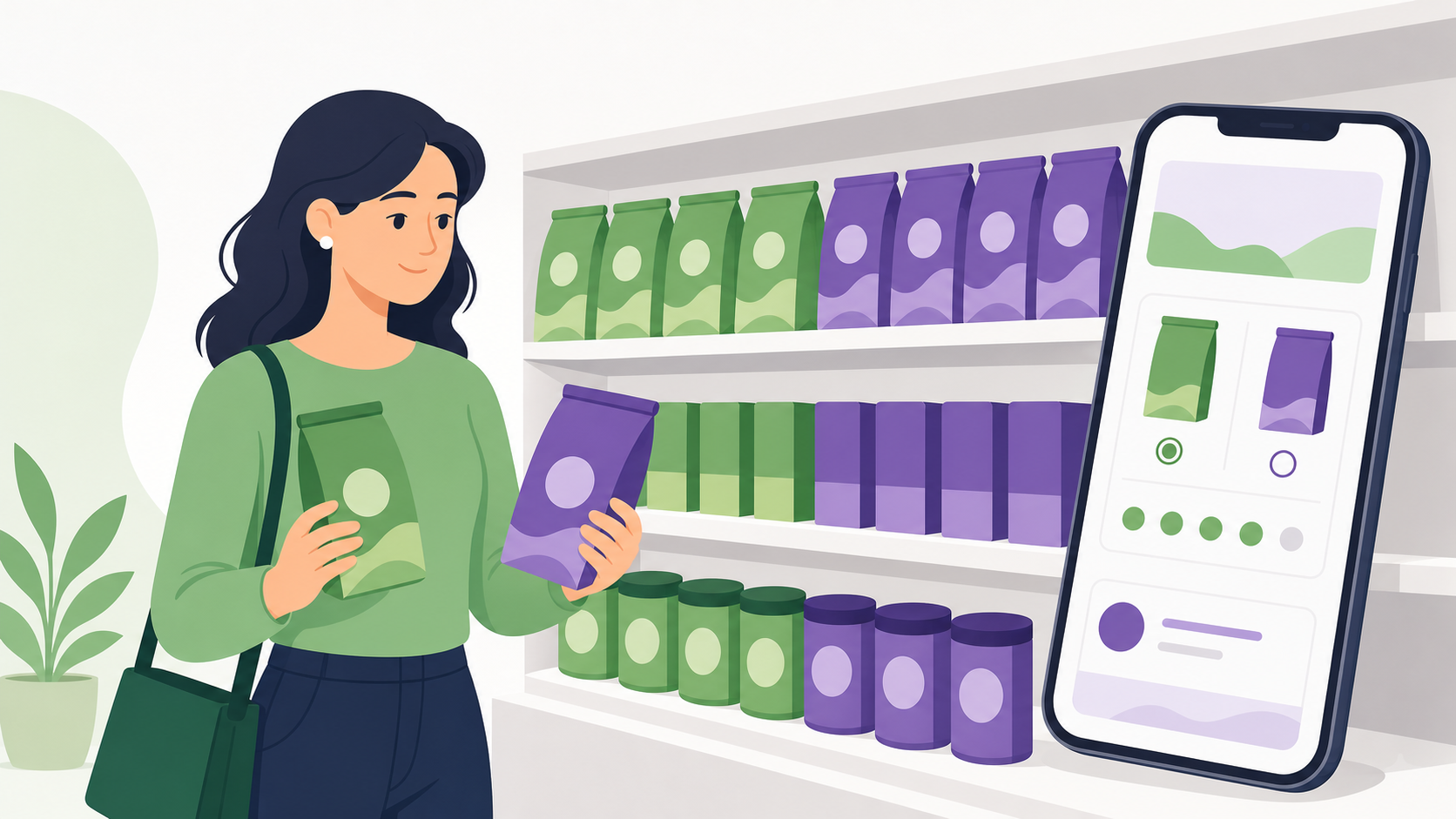
Pack tests. Show each design to a separate group of category buyers, or rotate designs, and measure standout, appeal, brand recognition and what the pack communicates. Online panels handle this well with high-quality images. If you need to test findability on a realistic shelf, an agency with shelf simulation is the stronger option.
Claim tests. Claims such as "no added sugar", "halal certified" or "kid-approved taste" are cheap to test and expensive to get wrong. A survey platform can measure believability, relevance and motivation for a list of claims in one study. Randomise claim order and keep wording identical to what would appear on pack.
Flavour concept tests. Before sampling physical product, test flavour concepts as short descriptions with an image. This narrows a long list to the two or three worth making. Physical taste tests then usually move to an agency or central location set-up.
Price tests. Simple approaches such as asking purchase likelihood at a small set of price points, or comparing price-pack options side by side, work well online. Keep the competitive context realistic and avoid showing every price to every respondent.
What design details matter most for Indonesian shoppers?
- Field the survey in Bahasa Indonesia, and check translated claims with someone who knows how the category talks on pack.
- Define category buyers by recent purchase, not just usage, so results reflect people who actually choose at shelf.
- Decide early whether you need separate reads for Greater Jakarta, other Java and outer islands, and plan sample per region.
- Show packs at a realistic size on mobile, since most respondents answer on a phone.
- Avoid fieldwork across Ramadan and Lebaran unless the test is about those occasions, as shopping behaviour shifts sharply.
- Include a current pack or claim as a benchmark so results have a reference point.
It also helps to agree a decision rule before fieldwork. For example, the team might decide that a new pack must match the current pack on brand recognition and beat it on standout before it moves forward. Setting the rule in advance stops a close result from turning into a long debate, and it makes the test easier to repeat for the next range.
Testing several packs or promotions in one survey brings its own bias risks. Our guide on testing packaging and promotion concepts without bias walks through rotation and cell design.
What does a fast FMCG test sequence look like?
Consider a ready-to-drink tea brand preparing a range extension. In week one, the team runs a claim test among recent RTD tea buyers to find which health and taste claims are most believable. In week two, they test three pack designs carrying the winning claim, each shown to a separate group. The winning pack then goes into a small price test against two competitor packs.
Each step answers one question with a short survey, and each result feeds the next brief. The team reaches a launch recommendation in a few weeks with clear evidence at every step, instead of waiting for one large study to answer everything at once.
How do you choose between platforms for a single test?
- Can the stimulus be shown fairly on a screen? If yes, an online panel platform is usually the fastest route.
- Do you have an analyst to script and clean data? If not, avoid sample-only options.
- Do you need physical product use? If yes, plan an agency-led in-home or central location test.
- How soon is the decision? Work back from that date and ask each platform for a realistic timeline.
Where does Vase.ai fit?
We build Vase.ai for FMCG teams that need fast quantitative pack, claim, flavour concept and price reads from a verified panel of Southeast Asian consumers, with AI-validated responses and results that update in a real-time dashboard as fieldwork runs.
If you are planning a wider set of studies for the Indonesian market, our guide to the best consumer research platforms for Indonesia FMCG explains how teams combine fast tests with larger tracking and segmentation work.
Frequently asked questions
What is the difference between a pack test and a concept test?
A concept test evaluates an idea, usually a description with an image. A pack test evaluates a finished or near-finished design for standout, communication and appeal. Pack tests usually come later and are more visual.
Can I test halal claims in a survey?
Yes. You can measure how important, believable and motivating a halal claim or logo is to different shoppers, and whether shoppers notice it on pack. Keep the wording and logo exactly as they would appear.
How quickly can an FMCG test run in Indonesia?
Short online tests among common category buyers can return results quickly once the questionnaire is approved. Niche audiences, regional quotas and longer questionnaires all extend fieldwork, so confirm feasibility first.