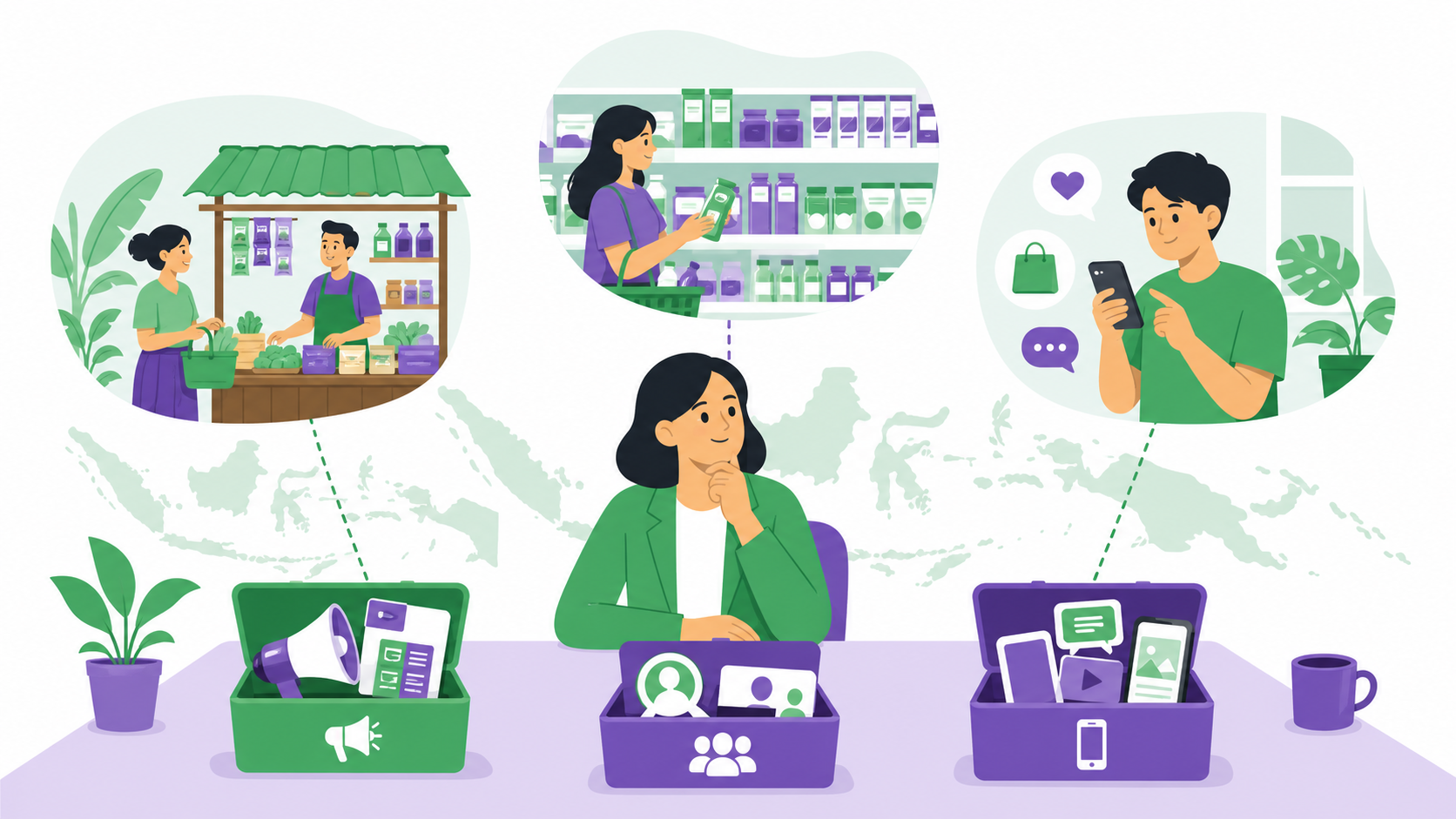

Quick answer: No single research platform is best for every Indonesia FMCG question. Match the platform to the research job: retail audit data for market share, agencies or platforms for usage and attitude studies, fast survey platforms for concept, pack and ad tests, and continuous trackers for brand health. Start from the decision you need to make, then pick the platform built for that job.
Why compare platforms by research job?
Most comparisons of Indonesia FMCG research platforms list providers and rank them. In practice, FMCG teams rarely use one provider for everything. A brand manager may rely on retail measurement for share, a global agency for an annual equity study, and a fast survey platform for weekly creative and pack decisions.
Organising the choice around the job makes it easier to see where each option earns its place, and where you might be over-paying in time or effort for a question that needs a quicker answer. It also helps when Indonesian specifics come into play, such as reading Java separately from other islands, or separating modern trade from traditional warung shoppers.
Which platform type fits each research job?
| Research job | Best-fit platform type | Examples of providers | Key Indonesia consideration |
|---|---|---|---|
| Market share and distribution | Retail measurement and household panels | NielsenIQ and other retail audit providers | Traditional trade coverage matters for many categories |
| Usage and attitude study | Full-service agency or research platform with expert support | Ipsos, Kantar | Regional and urban or rural splits in the sample |
| Concept and pack testing | Fast survey platform or agency innovation unit | Milieu Insight, NielsenIQ | Concepts adapted into natural Bahasa Indonesia |
| Ad and creative testing | Survey platform with video support or agency ad test | Kantar, Ipsos | Mobile-first viewing, since most respondents answer on phones |
| Brand health tracking | Continuous tracker on a consumer panel | YouGov, Milieu Insight | Ramadan and Lebaran seasonality |
| Audience profiling | Syndicated consumer profiling data | GWI | Check the depth of Indonesia data for your target group |
What does each job need from a platform?
Market share. You need sales or purchase records, not opinions. Retail measurement and household panels are the standard sources, and the debate is mainly about how well they cover traditional trade and e-commerce.
Usage and attitude. This is a broad foundation study about who buys the category, when, why and where. It needs careful questionnaire design and a well-structured sample, so expert involvement pays off even if you run it on a platform.
Concept, pack and ad tests. These are repeated, fast decisions. Speed, the ability to run rounds back to back, and clear diagnostics matter more than heavy custom reporting. Our guide to testing ad creative before a Southeast Asia campaign launch covers the ad side in depth.
Brand tracking. Consistency is everything. The questionnaire, sample definition and quotas should stay stable across waves, and the platform should report fast enough for the brand team to react within a campaign.
How do you check a platform's Indonesia readiness?
- Sample reach. Can the platform reach respondents outside Greater Jakarta, and can you read Java, Sumatra and other islands separately where bases allow?
- Respondent quality. Ask how panellists are verified and how fraudulent, duplicate or inattentive answers are removed.
- Language. Check that surveys run in Bahasa Indonesia and that translation is reviewed by native speakers.
- Channel profiling. You should be able to identify modern trade, traditional trade and online shoppers in the data.
- Mobile experience. Most respondents answer on smartphones, so long grids and heavy images will hurt data quality.
- Turnaround and iteration. For testing jobs, ask how quickly a second round can launch after the first one closes.
What does a strong brief look like for each job?
Whichever platform you choose, the brief decides the quality of the answer. A good brief names the decision, the audience, the markets or regions you need to read, and the date by which you need results. For FMCG work in Indonesia, add the channels that matter, the languages you will field in, and any seasonal timing, since fieldwork during Ramadan or around Lebaran can shift both availability and answers.
Be explicit about what success looks like. For a pack test, that might be standing out on a crowded shelf image and being correctly understood. For a tracker, it might be a steady read on consideration among mothers in Java outside Jakarta. Clear criteria let you compare providers fairly and judge the result without debate.
How should an FMCG team combine platforms?
- Use retail measurement as the source of truth for share and distribution.
- Run a usage and attitude study every few years, or when entering a new category.
- Use a fast survey platform for the steady flow of concept, pack and creative decisions.
- Keep one brand tracker running continuously, with a stable questionnaire.
- Bring the sources together in a monthly review so each answers the question it is best at.
This mix avoids the common trap of asking a slow, expensive study to answer a quick tactical question, or asking a quick test to carry a strategic decision it was never designed for.
Where does Vase.ai fit?
We build Vase.ai for the survey-based jobs in this mix: usage and attitude studies, concept and pack tests, ad tests and brand tracking, run on a verified panel of Southeast Asian consumers with AI-validated responses and a real-time dashboard. Teams can work DIY or with our research experts.
If your question is more about which providers serve Indonesian FMCG brands by channel and region, our earlier comparison of Indonesia FMCG research platforms by channel and region fit picks up exactly where this guide ends.
Frequently asked questions
What is the most common research job for FMCG brands in Indonesia?
Concept, pack and creative testing are usually the most frequent, because brands make these decisions many times a year. Brand tracking and usage and attitude studies run less often but shape strategy.
Do I need separate studies for modern and traditional trade shoppers?
Not always. One survey can cover both if you identify each respondent's main shopping channel and set quotas so both groups have readable bases.
Can one platform cover all FMCG research jobs?
Rarely. Retail measurement data answers share questions that surveys cannot, while survey platforms answer the why. Most teams combine a small number of sources, each used for the job it does best.