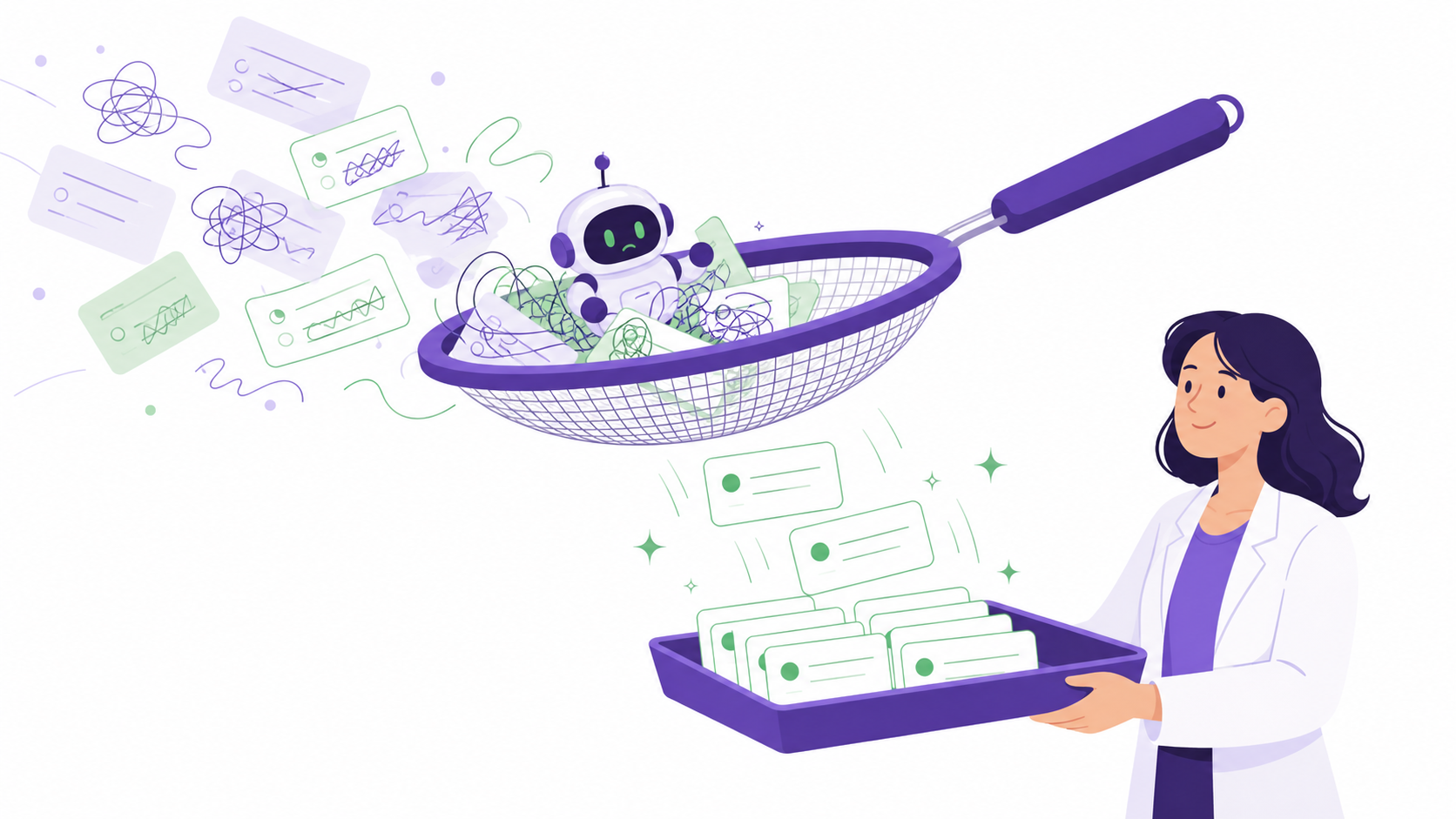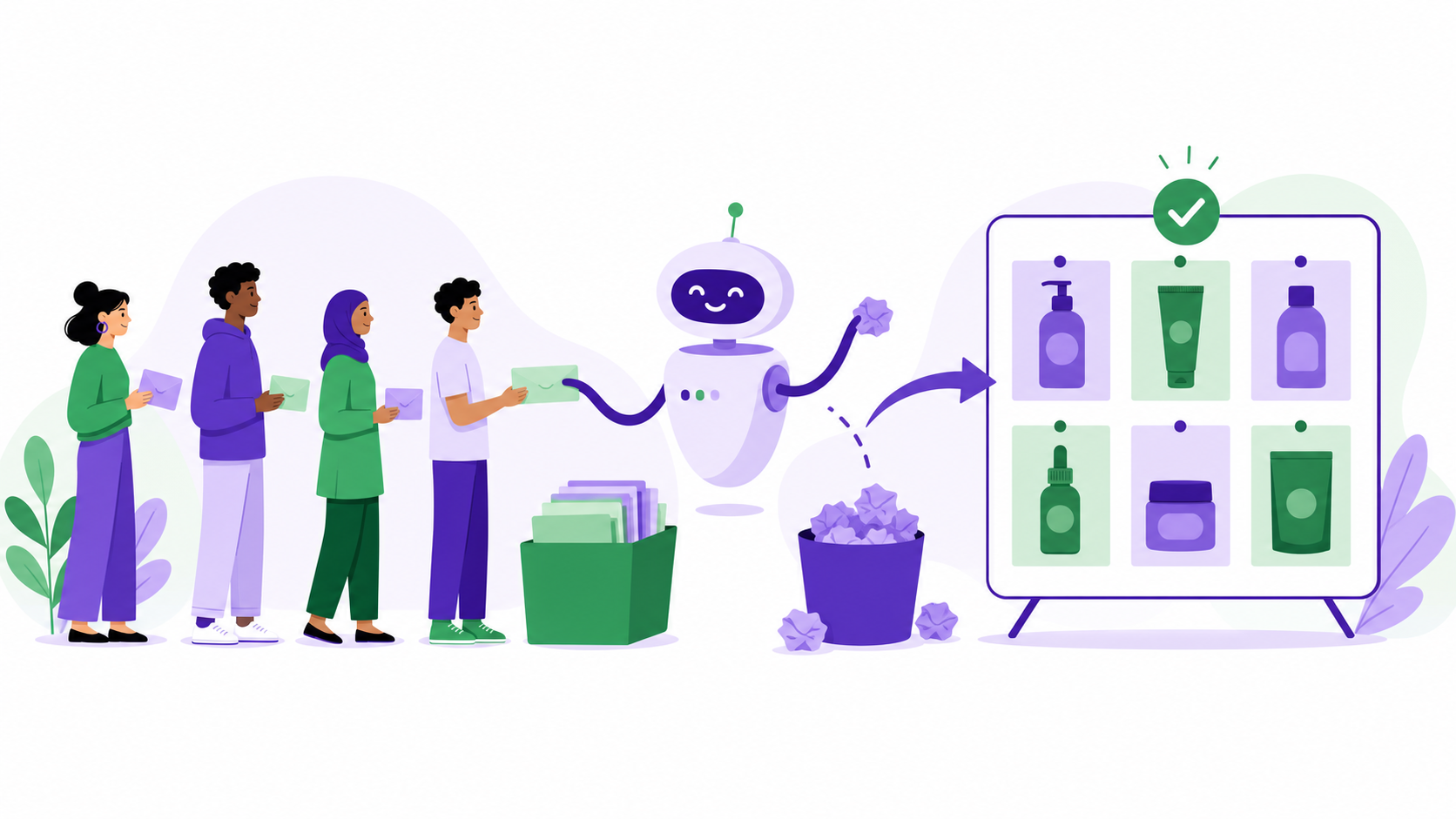

Quick answer: AI market research platforms speed up concept testing in four places: drafting the questionnaire, screening out low-quality or fraudulent answers, coding open-ended responses, and summarising results. The consumers answering are still real people, so the quality of the panel and the test design still decide whether the result can be trusted. Compare platforms on where the AI is applied and how much control you keep, not on the label.
What does 'AI' mean in a concept testing platform?
Almost every research platform now describes itself as AI-powered, which makes the label close to meaningless when you are choosing one. For concept testing, it helps to separate the stages of a test and ask where AI is actually doing the work, and where a human or a real consumer still is.
A concept test has a familiar shape: write the concept, design the questionnaire, recruit the right consumers, collect and clean the answers, analyse, and report. AI can help at most of these stages. It does not replace the consumers themselves, and it does not replace the judgement needed to turn a score into a launch decision.
Where does AI help at each stage of a concept test?
| Stage | What AI can do | What to check |
|---|---|---|
| Questionnaire design | Draft questions from a brief and flag leading or double-barrelled wording | Can a researcher review and edit everything before launch? |
| Respondent quality | Detect bots, duplicates, speeders and nonsense open-ended answers | Which checks run, and are removed responses replaced? |
| Open-ended coding | Group verbatim comments into themes in many languages | Can you see the raw comments behind each theme? |
| Analysis | Highlight significant differences between concepts and subgroups | Are significance tests and base sizes shown clearly? |
| Reporting | Summarise results in plain language in a dashboard | Is the summary traceable back to the data? |
How do the main types of AI research platform compare?
The market splits into a few broad groups. Survey software such as Qualtrics and SurveyMonkey has added AI features for question writing and text analysis, and you bring your own sample. Panel-based research platforms such as Milieu Insight and Vase.ai combine a consumer panel with AI in quality control and reporting, so a test runs end to end in one place. Global agencies such as Ipsos and Kantar use AI inside their own innovation testing products, with researchers interpreting results against their benchmarks.
| Platform type | Strength for concept testing | Best suited to |
|---|---|---|
| Survey software with AI features | Full control of design and analysis | Teams with in-house researchers and their own sample |
| Panel-based AI research platform | Speed from brief to results in one workflow | Brand teams testing concepts often |
| Agency innovation testing | Benchmarks and expert interpretation | Flagship launches needing a familiar, normed score |
For a broader view of AI platforms beyond concept testing, see our overview of AI market research platforms for consumer insights.
What questions should you ask an AI concept testing platform?
- Are the respondents real, verified consumers? Ask how the panel is recruited and verified in each market you need.
- What does the AI remove, and why? You should be able to see the quality rules and how many responses each one removed.
- Can I edit the questionnaire? AI drafts are a starting point. Your researchers need full control before launch.
- How are local languages handled? Coding open-ended answers in Bahasa Malaysia, Bahasa Indonesia, Thai or Vietnamese is harder than in English. Ask for an example.
- Can I trace a summary back to data? Every AI-written conclusion should link to the numbers and verbatims behind it.
- How fast is a second round? Iteration is where AI speed pays off most.
Our guide on what to look for in concept testing platforms adds checks on panel coverage, diagnostics and reporting.
How should you run your first AI-assisted concept test?
Start small and familiar. Pick a decision you would have tested anyway, such as choosing between two pack claims, and run it on the platform alongside your usual approach if you can. Compare the speed, the quality of the open-ended coding and how easy the results are to share with stakeholders.
Set your action standard before the data arrives, for example that a concept must beat the current product on purchase intent among category buyers. Write the brief as you would for any agency, then let the AI draft the questionnaire and have a researcher tighten it. Review which responses were removed and why. After two or three tests you will know where the AI genuinely saves time for your team, and where human review still adds the most value.
What can AI not do in concept testing?
- It cannot tell you how real consumers will react without asking them.
- It cannot fix a weak concept board or a poorly defined target audience.
- It cannot decide your action standard, the score a concept must beat to go forward.
- It cannot weigh commercial factors such as margin, supply or retailer appetite.
Used well, AI removes the slow, manual parts of a concept test so researchers and brand teams can spend their time on the decision itself.
Where does Vase.ai fit?
We build Vase.ai to apply AI where it protects concept tests most: validating responses so low-quality answers are removed before results reach your real-time dashboard. The respondents are real people from a verified panel of Southeast Asian consumers.
Teams run concept tests DIY on the platform when they want speed and control, or work with our research experts on design and a full report when the stakes are higher. Either way, the workflow stays in one place, from brief to dashboard, so a second round can follow the first without starting again.
Frequently asked questions
Is AI concept testing as reliable as traditional concept testing?
It can be, provided the respondents are real, verified consumers and the questionnaire is well designed. AI mainly changes the speed and cost of the process, not the logic of a good test.
Can AI predict how a concept will perform without a survey?
AI models can offer early signals, but they are not a substitute for asking real consumers in your target market. For launch decisions, a quantitative test with real respondents remains the standard.
How many concepts should I test at once?
Two to five concepts per test is a common range. More concepts per respondent increases fatigue, so larger sets are usually split across respondent groups.