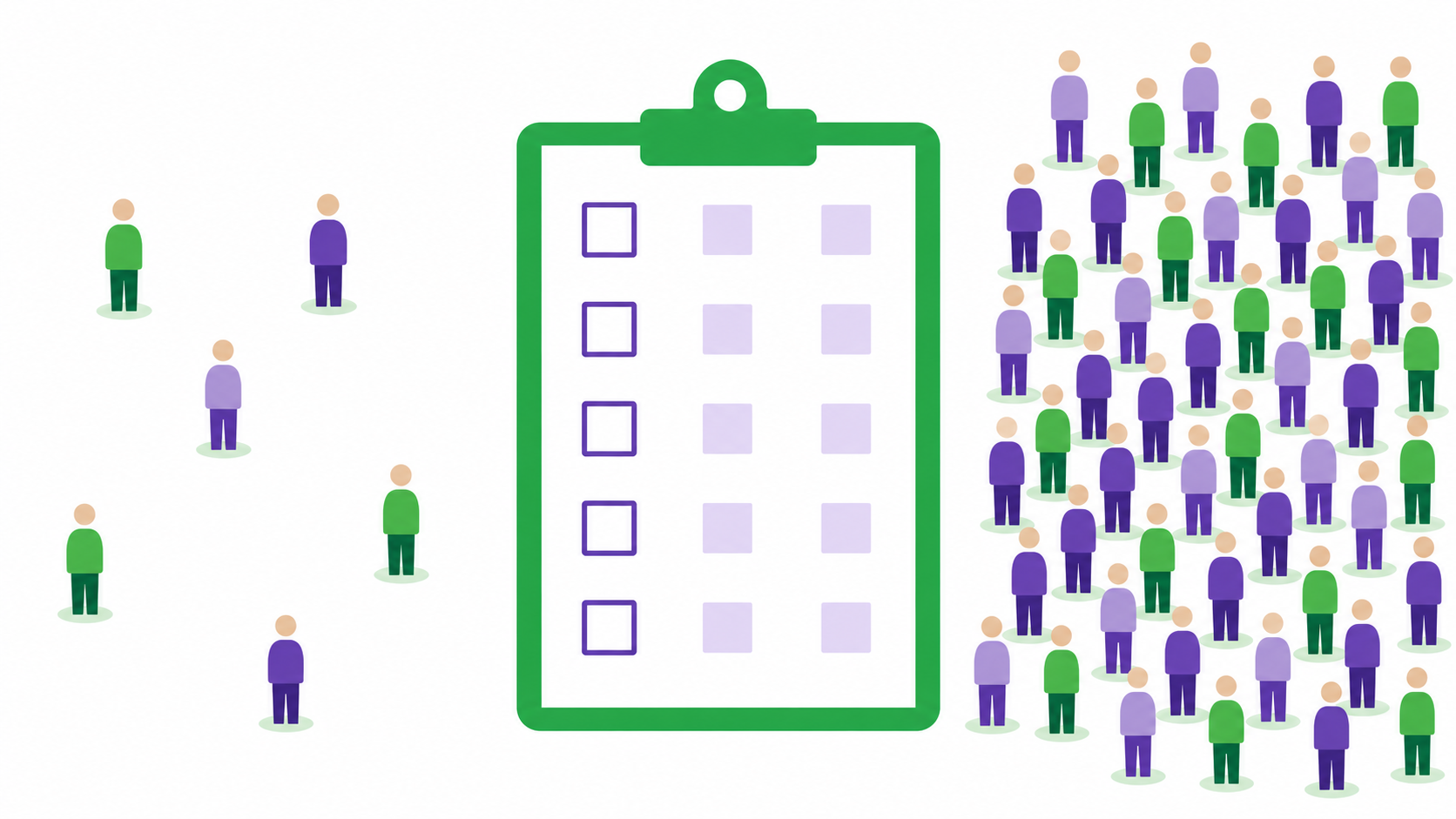

Determining the right sample size is one of the most common questions in market research. The answer depends on what you’re trying to achieve: 100-200 respondents work for directional insights and pitch validation, while 300-400+ respondents are needed for confident business decisions. This guide breaks down sample size requirements across different research scenarios, explains the statistics behind the numbers, and helps you budget appropriately.
Data compiled from 500+ projects conducted across Southeast Asia, combined with ESOMAR guidelines and industry benchmarks.
Here's What We'll Cover:
- 1. The Statistics Behind Sample Size
- 2. Minimum Sample Sizes: It Depends on Your Purpose
- 3. Sample Size Requirements by Research Type
- 4. Understanding Booster Samples for Segment Analysis
- 5. Real-World Examples from Southeast Asia
- 6. How to Verify Your Sample is Representative
- 7. Common Mistakes in Sample Size Planning
- 8. Online vs. Offline Sampling: Making the Right Choice
- 9. Choosing Between DIY Platforms and Full-Service Research
- 10. Budgeting for Your Sample Size
- 11. Frequently Asked Questions
1. The Statistics Behind Sample Size
Sample size calculations rest on two key concepts: confidence level and margin of error. Understanding these helps you make informed decisions rather than defaulting to arbitrary numbers.
A 95% confidence level (the industry standard) means that if you repeated your survey 100 times with the same methodology, your results would fall within your margin of error 95 times. The margin of error tells you the range within which your true population value likely falls.
Here’s how sample size affects margin of error at 95% confidence:
| Sample Size |
Margin of Error |
Best Use Case |
| 100 | ±9.8% | Early exploration, B2B research, pitch validation |
| 200 |
±6.9% | Directional insights, internal presentations |
| 300 |
±5.7% | Standard research, most business decisions |
| 400 | ±4.9% | Industry standard for reliable consumer insights |
| 600 |
±4.0% | Brand tracking, sub-group analysis |
| 1,000 |
±3.1% | Segmentation, national representation |
| 2,500 |
±2.0% | Policy decisions, major strategic shifts |
For populations over 100,000 (which includes most consumer research), population size has minimal impact on these calculations. A sample of 400 provides the same margin of error whether you’re researching a city of 500,000 or a country of 30 million.
2. Minimum Sample Sizes: It Depends on Your Purpose
One of the most persistent questions is: “What’s the absolute minimum sample size?” The honest answer is that it depends entirely on what you’re using the research for.
For pitch presentations and early validation (100-200 respondents): When agencies or startups need directional data to support a pitch or validate an early hypothesis, 100-200 respondents can provide useful indication. At this level, you’re looking at ±7-10% margin of error. The data shouldn’t drive major business decisions, but it’s sufficient for saying “our initial research suggests…” in a pitch deck.
For internal decision-making (300-400 respondents): Most standard business research operates at 300-400 respondents. This delivers a ±5% margin of error, which is precise enough for product decisions, pricing studies, and campaign testing. This is the sweet spot where statistical reliability meets budget efficiency.
For high-stakes decisions (500+ respondents): When research will inform significant investments, organizational changes, or public-facing claims, larger samples reduce risk. Brand tracking studies typically run 600+ respondents per wave to detect meaningful changes over time.
3. Sample Size Requirements by Research Type
Different research objectives require different sample architectures. Here’s what industry benchmarks suggest across common use cases.
1. Brand Awareness Studies: 400-600 Respondents
Brand awareness tracking requires sufficient sample to measure changes reliably over time. Industry standard for consumer brand awareness studies is 400-600 respondents, providing a ±4-5% margin of error.
This sample size allows you to:
-
Detect meaningful shifts in awareness (>3-4 points) between waves
-
Compare awareness across 2-3 demographic segments
-
Track unaided recall, aided awareness, and consideration metrics
Typical project costs in Southeast Asia:
-
DIY/Platform: RM 15,000-25,000
-
Managed Service: RM 25,000-40,000
-
Full-Service Agency: RM 50,000-80,000
For a comprehensive breakdown of research costs, see our Market Research Pricing Guide.
2. Product Concept Testing: Choosing the Right Methodology
Concept testing sample size depends heavily on your chosen methodology. There are two primary approaches:
A. Monadic Testing (Each Respondent Sees ONE Concept)
- Requires 100-200 respondents per concept
- Testing 4 concepts = 400-800 total respondents
- Best for: Deep evaluation, eliminating comparison bias, high-stakes decisions
- Higher cost due to larger total sample
B. Sequential Monadic Testing (Each Respondent Sees ALL Concepts)
- Requires only 100-300 total respondents
- Each respondent evaluates all concepts in randomized order
- Best for: Early-stage screening, budget efficiency, comparing multiple concepts
- Lower cost, but introduces order effects
When to use each approach:
| Scenario | Recommended Approach | Sample Size |
| Screening 5+ concepts | Sequential Monadic | 200-400 total |
| Final validation of 2-3 concepts | Monadic | 150-200 per concept |
| Budget under RM 15,000 | Sequential Monadic | 200-300 total |
| Many questions per concept (15+) | Monadic | 150-200 per concept |
| Quick directional read | Sequential Monadic | 150-200 total |
Hybrid approach: Many researchers screen concepts using sequential monadic, then validate the top 2-3 finalists using monadic testing.
Typical concept testing costs in Southeast Asia:
-
2-4 concepts, sequential monadic: RM 8,000-20,000
-
2-4 concepts, full monadic: RM 15,000-35,000
3. Brand Tracking: 600-800 Respondents per Wave
Brand tracking studies measure change over time, which requires consistent, larger samples. Larger samples reduce variance between waves, making genuine shifts in perception distinguishable from statistical noise.
Why 600-800 respondents?
-
Detects 3%+ changes with confidence
-
Allows demographic sub-group analysis
-
Maintains consistency across quarterly/monthly waves
Tracking studies typically include demographic quotas to ensure representation across age, income, and lifestyle segments. Annual tracking programs (4 waves) typically invest:
-
Platform model: RM 50,000-80,000 annually
-
Full-service: RM 180,000-300,000 annually
4. Segmentation Studies: 800-1,200 Respondents
When identifying distinct consumer segments, you need enough respondents within each segment for reliable sub-group analysis. If your analysis identifies 5 segments, a 1,000-respondent sample provides approximately 200 respondents per segment.
A regional e-commerce platform analyzing shopper behavior deployed 1,000 respondents with detailed questioning on device usage, payment preferences, and satisfaction drivers. This enabled identification of 5 meaningful segments with 150-250 respondents each.
5. Nationally Representative Studies: 1,500-2,500 Respondents
True national representation with demographic quotas across age, gender, income, and region requires substantial sample sizes. A 2,500-respondent study is common for research requiring state or provincial-level breakouts while maintaining national-level precision.
For reference, Malaysia’s Department of Statistics (DOSM) household surveys typically sample 80,000+ households for census-level accuracy. For business research, 1,500-2,500 provides sufficient precision for most national insights.
4. Understanding Booster Samples for Segment Analysis
When you need deeper insights into specific segments without inflating overall sample size, booster samples provide an efficient solution.
Here’s how it works:
-
Sample the general market proportionally to understand overall trends
-
Add “boosters” for segments you care most about
-
Analyze separately: General market sample for market-level insights; boosted segment for segment-specific insights
Example: A telecommunications company wants to understand the general smartphone market (n=400) but needs deeper insights into high-value customers (typically 15% of population, or just 60 respondents in a proportional sample).
Rather than expanding the entire sample to 2,000+ to get 300 high-value customers, they:
-
Conduct general market research with 400 respondents (proportionally sampled)
-
Add a booster sample of 200 additional high-value customers
-
Analyze general market insights from the 400-sample
-
Analyze high-value segment insights from the 260 total (60 from general + 200 booster)
This approach costs significantly less than expanding the entire sample while providing robust segment-level insights.
5. Real-World Examples from Southeast Asia
1. Case Study: Automotive Customer Satisfaction
Company: A leading used car platform in Southeast Asia
Objective: Benchmark customer satisfaction across purchase journey touchpoints
Sample Design: 500 respondents across Malaysia Margin of
Error: ±4.4%
Outcome: Identified three key friction points in the post-purchase experience, leading to process improvements that increased NPS by 12 points.
2. Case Study: Quarterly Brand Health Tracking
Company: Multinational consumer brand
Objective: Track brand perception across 8 dimensions quarterly
Sample Design: 600 respondents per wave, stratified by region and urban/rural Margin of Error: ±4.0% per wave
Annual Investment: RM 50,000-60,000 through platform model
This client has run 12 consecutive quarterly waves, creating a longitudinal dataset spanning three years. The consistent 600-respondent sample enables detection of meaningful changes (>3%) in brand perception with confidence.
3. Case Study: Concept Testing with Sequential Monadic Design
Company: Leading FMCG brand (beverage sector)
Objective: Screen 5 flavor concepts for regional launch
Sample Design: 300 respondents, each evaluating all 5 concepts (sequential monadic) Margin of
Error: ±5.7%
Investment: RM 8,000 + SST
Timeline: 10 days from launch to insights
Using sequential monadic design kept costs low while providing clear ranking of concepts. The study identified 2 clear winners, which the client then validated with a follow-up monadic test (200 respondents per concept) before final launch decision.
6. How to Verify Your Sample is Representative
A common concern is whether your sample actually represents the population you’re studying. Here’s how to validate representativeness:
Compare to official statistics: Each country publishes demographic data that serves as your benchmark:
- Malaysia: Department of Statistics Malaysia (DOSM) - population estimates by age, gender, ethnicity, and state
- Singapore: Singapore Department of Statistics - resident population breakdowns
- Indonesia: Badan Pusat Statistik (BPS) - census and inter-census data
- Thailand: National Statistical Office (NSO) - household and demographic surveys
- Philippines: Philippine Statistics Authority (PSA) - census data
- Vietnam: General Statistics Office (GSO) - population and housing census data
Compare your sample’s age, gender, and income distribution against these benchmarks. If your sample over-represents any group by more than 5-10 percentage points, consider weighting your data or adjusting quotas.
Check completion quality: Representative samples also require quality responses. Monitor completion time, attention check performance, and response patterns. Quality panels typically achieve 40-60% completion rates with pre-screened participants, compared to 15-25% for general recruitment.
7. Common Mistakes in Sample Size Planning
Undersizing for sub-group analysis: Planning 400 respondents while needing to report across 8 sub-groups leaves only 50 respondents per group. If sub-group analysis matters, factor this into sizing upfront.
Confusing population size with sample size: A common misconception is that larger populations require larger samples. Statistically, sample size is determined by variability and acceptable margin of error, not population size.
Using monadic when sequential would suffice: If you’re screening many concepts and don’t need deep evaluation per concept, sequential monadic can deliver insights at 30-50% of the cost.
Over-sampling without reason: “Bigger is better” wastes budget. Once you exceed 1,200 respondents for standard analysis, marginal value per additional respondent diminishes significantly.
Mixing online and offline samples carelessly: If combining online and offline data, ensure both are sampled from equivalent population definitions. Otherwise, comparisons become unreliable.
8. Online vs. Offline Sampling: Making the Right Choice
A strategic principle for sampling: your research methodology should match your business context. If your marketing strategy targets online consumers, your research should sample online consumers. If you’re reaching customers through offline channels, offline sampling (or weighted online samples) may be more appropriate.
Online panels now represent the majority of consumer research across Southeast Asia, typically ranging from 3-5 million panelists across major platforms. These panels work well for digitally active populations but naturally skew toward internet users.
For products targeting offline-heavy demographics (rural consumers, elderly populations, low-income segments), consider blended approaches or offline data collection methods.
9. Choosing Between DIY Platforms and Full-Service Research
Modern research providers typically offer two service models:
1. DIY/Self-Service Platform
-
You design, launch, and analyze surveys yourself
-
Platform provides panel access, survey tools, and basic reporting
-
Best for: Teams with research experience, simple studies, tight budgets, fast turnaround
-
Cost: RM 5,000-40,000 depending on sample size
2. Full-Service Research
-
Provider handles everything: methodology, questionnaire, fieldwork, analysis, reporting
-
You receive strategic recommendations and presentation-ready deliverables
-
Best for: Complex studies, no internal research capability, executive presentations
-
Cost: RM 25,000-150,000+ depending on scope
3. Hybrid/Managed Service
-
Platform access with expert guidance throughout
-
Provider reviews questionnaire, ensures quality, provides analysis support
-
Best for: Teams wanting efficiency with expert oversight
-
Cost: RM 12,000-60,000 depending on scope
The right choice depends on your internal capabilities, timeline, and how the research will be used.
10. Budgeting for Your Sample Size
Sample size directly impacts project cost. Here’s how to think about budgeting across Southeast Asian markets:
DIY/Platform Research:
-
100-200 respondents: RM 2,000-5,000
-
300-400 respondents: RM 5,000-12,000
-
600-800 respondents: RM 15,000-25,000
-
1,000+ respondents: RM 25,000-40,000
Managed Service/Guided Platform:
-
300-400 respondents: RM 12,000-20,000
-
600-800 respondents: RM 25,000-40,000
-
1,000+ respondents: RM 40,000-60,000
Full-Service Agencies:
-
Boutique agencies: RM 25,000-60,000
-
Large multinational research firms: RM 50,000-150,000+
Prices exclude 8% SST. For detailed pricing breakdown, see our Market Research Pricing Guide.

Frequently Asked Questions
Conclusion: Right-Size Your Research Investment
The right sample size balances statistical rigor with practical constraints. The industry standard of 400+ respondents exists for good reason: it delivers ±5% margin of error, which supports confident business decisions without excessive cost.
Key takeaways:
-
100-200 respondents: Suitable for pitches and early validation (±7-10% margin of error)
-
300-400 respondents: Standard for most business decisions (±5-6% margin of error)
-
400-600 respondents: Industry standard for brand awareness and tracking
-
600+ respondents: Required for tracking studies and sub-group analysis
-
1,000+ respondents: Necessary for segmentation and multi-dimensional analysis
Use official statistics (DOSM, BPS, etc.) to validate representativeness. Consider booster samples for segment-level depth. Choose between monadic and sequential monadic based on your concept testing goals and budget.
The best sample size isn’t the largest one. It’s the one that answers your specific question with the precision your decision requires.
About This Guide
This guide draws on industry benchmarks, ESOMAR guidelines, and project data from 500+ studies conducted across Southeast Asia. Vase.ai, a Southeast Asia research platform headquartered in Malaysia, contributed pricing benchmarks and methodology insights. Their platform provides access to 3.6M consumers across Malaysia, Singapore, Indonesia, Thailand, Philippines, and Vietnam.
Vase.ai offers both self-service platform access and full-service research, allowing teams to choose the model that fits their needs. For research consultation or custom project quotes, visit vase.ai.
Last updated: February 2026. Prices are indicative and subject to change. All prices exclude 8% SST unless otherwise noted.