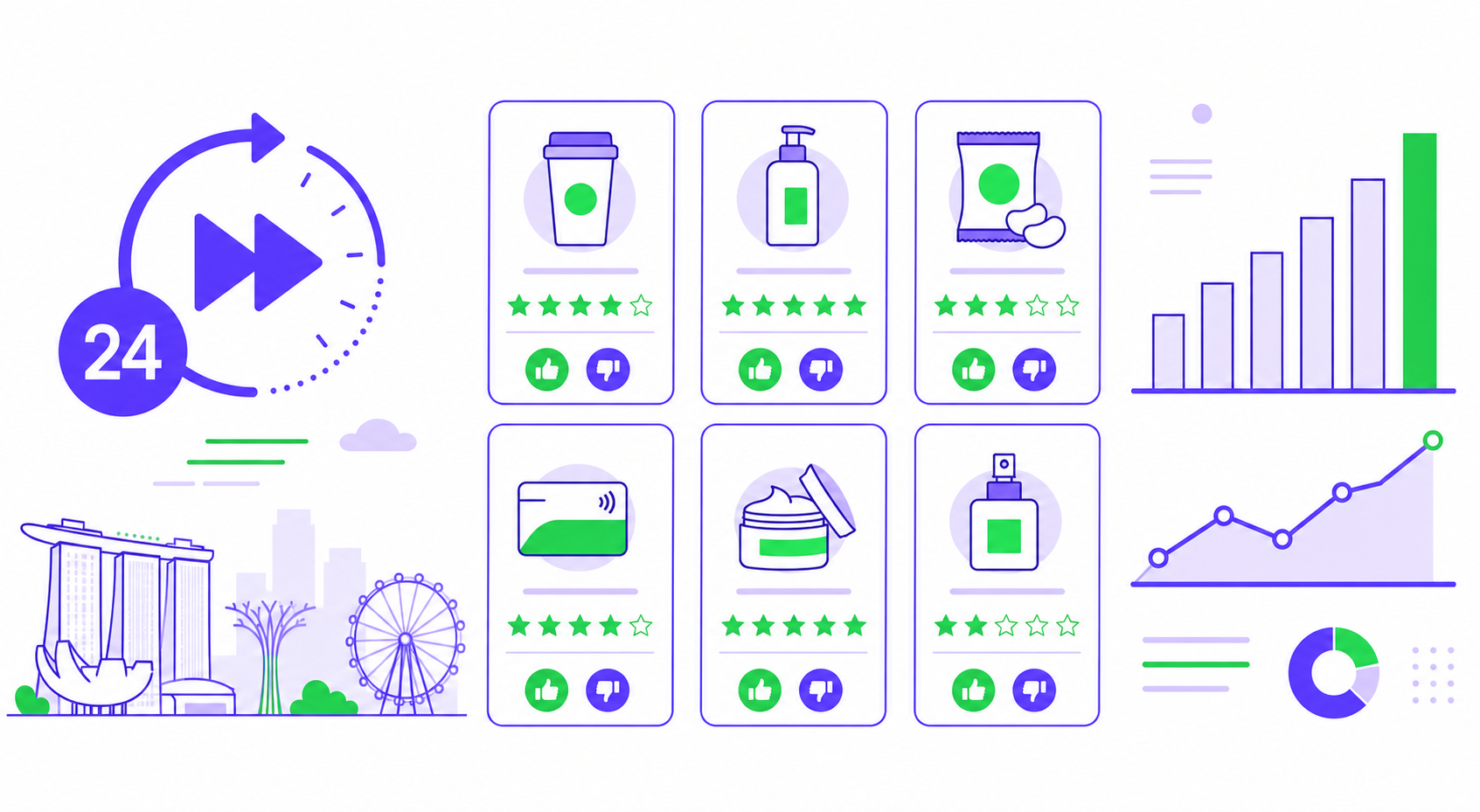

Fast concept testing lets Singapore brands validate product, packaging, and campaign ideas with real consumers in about 24 hours instead of weeks. The most useful facts to know: modern platforms reach verified local panels quickly, small screening samples can reliably rank ideas early, and speed does not have to cost statistical rigour when sampling and methodology are handled properly.
Concept testing used to be a multi-week exercise that many Singapore teams skipped under launch pressure. That is changing. Automated research platforms now recruit verified respondents, run monadic or comparative designs, and return dashboards the next day. Below are eight practical facts that help marketing, insights, and product teams in Singapore use fast concept testing well, without trading away the quality that makes results worth acting on.
1. Results can be ready in about 24 hours
The headline change is turnaround. Where traditional agency concept tests took two to four weeks, automated platforms with standing panels can field a study and deliver analysed results within roughly a day. For Singapore teams working to tight campaign or launch calendars, that means concept decisions fit inside a sprint rather than blocking it.
2. Speed does not require sacrificing rigour
Faster does not have to mean sloppier. The time saved comes from automation of recruitment, routing, and tabulation, not from cutting corners on design. A well-run fast test still uses proper sampling, randomisation, and validated question formats, so a 24-hour result can be as trustworthy as a slower one when the platform is built correctly.
3. Monadic testing gives the cleanest read
In a monadic design each respondent evaluates a single concept in isolation, which mirrors how consumers actually encounter products in the real world. It avoids the bias that creeps in when people compare options side by side. When you need an absolute read on how a concept performs rather than only a relative ranking, monadic is the stronger choice.
4. Small samples can screen ideas early
You do not always need hundreds of respondents. For an early-stage screen that separates clearly strong ideas from weak ones, a smaller sample can be enough to rank direction and kill non-starters cheaply. Reserve larger, more precise samples for the final concepts that will actually go to market, where the cost of a wrong call is highest.
5. Local, verified panels matter in Singapore
Singapore is small, multilingual, and demographically specific, so a generic regional panel can misrepresent local taste. Fast concept testing is only useful if the respondents are genuinely local and verified. Look for platforms that can reach the right age, language, and income segments in-market, and that screen out fraudulent or professional survey-takers.
6. Standardised metrics make concepts comparable
Consistent measures such as purchase intent, appeal, uniqueness, and relevance let you benchmark one concept against another and against past tests. When every study uses the same scales and definitions, results build into a library of norms, so you can quickly see whether a new idea is genuinely above average for your category.
7. Open-ended feedback explains the "why"
Scores tell you which concept wins, but open-ended responses tell you why, and what to fix. Fast platforms increasingly use AI to summarise verbatim comments into themes in minutes, so you get both the quantitative ranking and the qualitative reasoning in the same 24-hour cycle. That combination is what turns a test result into a design decision.
8. Iterating fast beats testing once
The real advantage of speed is iteration. When a test costs a day rather than a month, you can test, refine, and retest a concept several times before launch. Teams that treat concept testing as a loop rather than a one-off gate consistently ship stronger ideas, because each round removes a weakness the last round exposed.
Fast vs. traditional concept testing at a glance
| Dimension | Fast (automated) testing | Traditional testing |
|---|---|---|
| Turnaround | ~24 hours | 2–4 weeks |
| Cost per test | Lower, scalable | Higher, project-based |
| Iteration | Multiple rounds feasible | Usually one round |
| Analysis | Automated dashboard + AI summaries | Manual, analyst-led |
| Best for | Screening, iteration, tight timelines | Deep, bespoke studies |
When is Vase.ai the right fit, and when not?
We would back Vase.ai for Singapore concept testing where incidence rather than panel size is usually the binding constraint and you want the screening definition interrogated before you commit to a base. Our panel covers 3.6 million verified Southeast Asian consumers, fieldwork can complete in as little as 24 hours, and studies start from around RM5,000 (about USD 1,000), DIY or with our research experts. Where we are honestly not the best fit: if you need concept norms built over years, Kantar and Ipsos hold them. NielsenIQ is right when the question is retail performance rather than pre-launch appeal. For a fundamentally qualitative exploration ahead of quantification, use a qualitative specialist and bring us in for the numbers.
Frequently asked questions
How fast can concept testing really be?
With an automated platform and a standing local panel, a concept test can be fielded and analysed in around 24 hours. The speed comes from automating recruitment and tabulation, so the research design itself stays intact.
Is fast concept testing accurate enough to act on?
Yes, when the platform uses verified panels, proper sampling, and validated question formats. Speed affects how quickly you get results, not whether the underlying method is sound, so a well-run fast test can be trusted for real decisions.
How many respondents do I need for a concept test in Singapore?
It depends on the stage. A smaller sample can screen and rank early ideas, while final concepts heading to market benefit from a larger, more precise sample. The right number balances the cost of the test against the cost of a wrong launch decision.
Keep exploring fast, confident concept testing and product-launch research on the Vase.ai blog: