
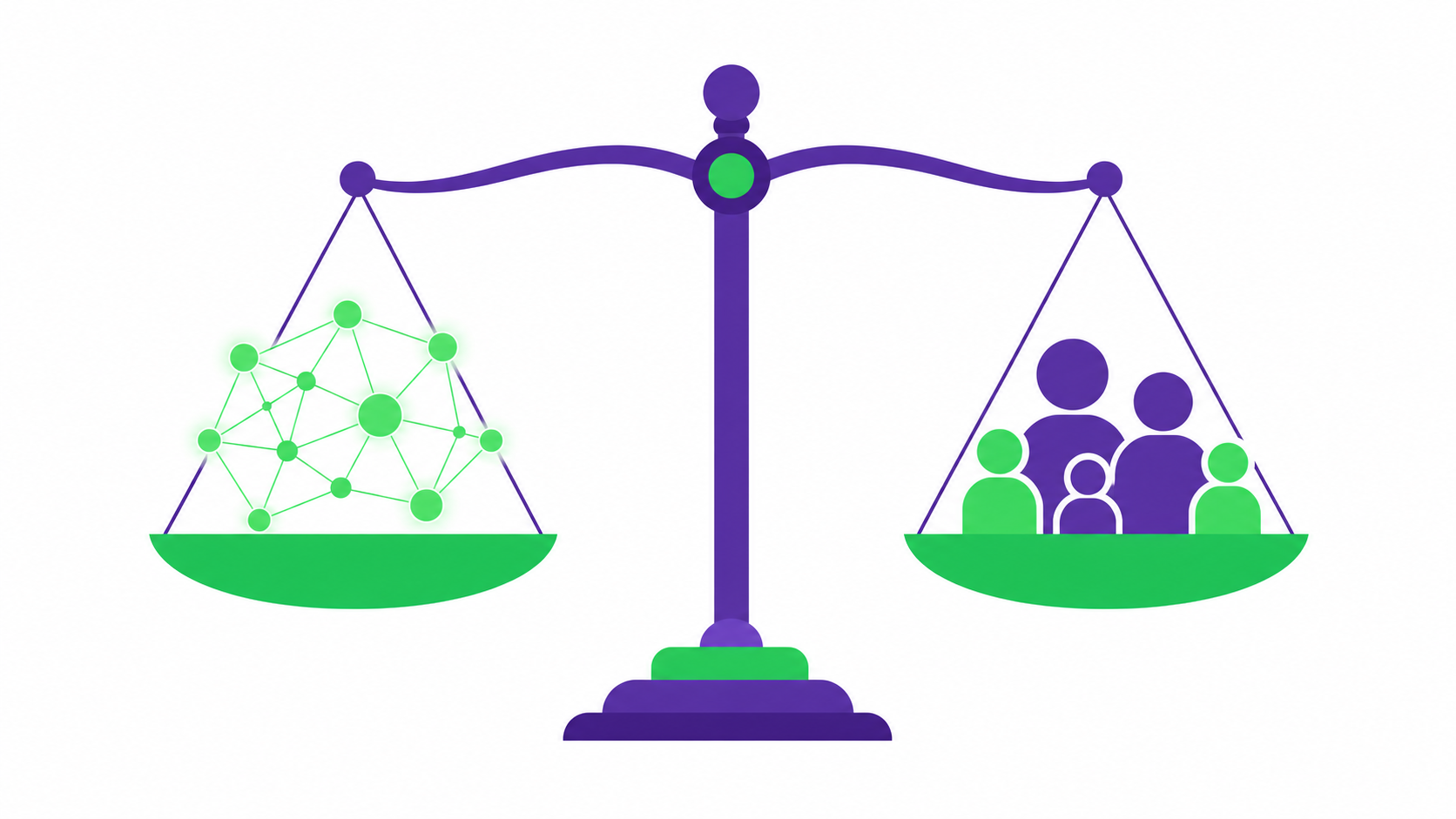

Quick answer: AI market research means using machine learning to speed up and quality-check research with real consumers, not to replace those consumers. The ten things worth knowing: AI compresses timelines from weeks to days, it lowers cost enough to change what you test, it is genuinely good at validating responses and coding open ends, and it makes always-on tracking affordable. It also cannot invent a market it has never observed, it summarises thin data as confidently as thick data, it inherits every flaw in the panel underneath, and it cannot make your decision. We build Vase.ai, so treat this as an interested but honest account.
What does AI market research actually mean?
1. It is a stack of tools, not a single product. When a vendor says AI research, they could mean any of five quite different things: AI-assisted survey building, AI validation of incoming responses, AI coding of open-ended answers, AI-written summaries and reports, or fully synthetic respondents generated by a model. These sit at very different points on the trust scale. The first four operate on data collected from real people. The last one does not. Before you compare two platforms on price, establish which of the five you are actually buying, because a demo that looks similar can rest on completely different foundations.
Where does AI genuinely improve consumer research?
2. The speed gain is a step change, not a trim. Traditional agency projects run six to twelve weeks from brief to debrief, most of it spent on manual scripting, manual quality checks, and report writing. Automating those steps brings a straightforward quantitative study down to days. On Vase.ai, studies can return insights in as little as 24 hours. That matters less as a boast and more as a behaviour change: research that lands inside a planning meeting gets used, research that lands a month later gets filed.
3. Lower cost changes what you are willing to test. When a study starts from around RM5,000 (roughly USD 1,000), the calculation shifts. Teams stop reserving research for the one big annual decision and start testing the three packaging routes, the two price points, and the campaign idea nobody in the room agrees on. The value is not the saving on any single project. It is the number of decisions that stop being guesses.
4. Response validation is the most mature and least glamorous use. This is where AI earns its place quietly. Models are good at spotting straightlining, impossibly fast completions, duplicate devices, contradictory answers across a questionnaire, and low-effort open ends that have been pasted in. Every panel in the world has some proportion of low-quality respondents. Automated validation catches far more of them, far more consistently, than a human reviewing a spreadsheet at the end of fieldwork.
5. Open-end coding at scale is a real unlock in Southeast Asia. Verbatim answers are the most useful and most neglected part of most surveys, because coding a thousand of them by hand is slow and expensive. In Southeast Asia the problem multiplies, because those thousand answers arrive in Malay, English, Mandarin, Thai and Bahasa Indonesia, often mixed within a single sentence. Machine coding makes it practical to read the whole set rather than the first fifty.
6. Always-on tracking becomes affordable rather than aspirational. Most brand trackers are annual because the manual cost of a wave is high. Automate scripting, fielding, validation and charting, and quarterly or monthly waves become realistic for a mid-sized brand. A real-time dashboard also changes who uses the data, because the brand manager can look on a Tuesday instead of waiting for the deck.
Where does AI still get research wrong?
7. Synthetic respondents cannot report on a market they have never seen. Fully generated respondents are the most heavily marketed and least reliable form of AI research. A model can produce a plausible answer about a familiar category in a well-documented market. It cannot tell you how Malaysian shoppers will react to a new flavour launched with a Ramadan promotional mechanic against a local competitor that barely appears in English-language text. Southeast Asian consumer behaviour is thinly represented in training data, which is precisely where synthetic answers feel most confident and are least trustworthy.
8. Generated summaries sound identical on strong and weak data. An AI report will describe a six-point gap on a base of 80 in the same assured prose it uses for a six-point gap on a base of 800. The writing quality is constant, the statistical support is not. Always read the base size next to the claim, and be sceptical of any subgroup finding the tool has volunteered without flagging its sample.
9. AI cannot repair a weak panel. This is the single most important point on the list. Every AI feature above operates downstream of sampling. If the respondents are not who they claim to be, or the sample skews to whoever is cheapest to reach, faster processing simply delivers the wrong answer sooner. Ask who owns the panel, how identity is verified, and what the profiling depth looks like in each market you care about. Our own panel covers 3.6 million verified consumers across Southeast Asia, and we would still tell you to ask a competitor the same three questions.
10. No model will set your decision rule for you. Deciding that a concept proceeds above a given purchase intent threshold, or that a tracker dip triggers a creative review, is a commercial judgement. Agree it before fieldwork. Otherwise the most sophisticated analysis in the world just becomes material for whoever argues hardest in the meeting.
| Task | Trust AI with it? | Why |
|---|---|---|
| Response validation | Yes | Pattern detection at scale, checkable rules |
| Open-end coding | Yes, with spot checks | Handles multilingual volume humans cannot |
| First-draft analysis | Yes, then verify | Fast starting point, weak on base sizes |
| Sampling and recruitment | Only as automation | Quality comes from the panel, not the model |
| Replacing respondents | No | Thin SEA training data, unfalsifiable output |
| Setting decision rules | No | Commercial judgement, not a data task |
How should you interrogate a vendor's AI claims?
Four questions separate substance from slideware. First, which of the five AI uses does your product actually perform? Second, are any respondents in my study synthetic, and if so what proportion? Third, what does your validation reject, and what rejection rate do you typically see in my market? Fourth, can I export the raw data and re-run the analysis myself? A vendor confident in its AI will answer all four plainly. If the answers arrive as adjectives rather than specifics, that tells you something useful.
When is Vase.ai the right fit, and when is someone else better?
We would back Vase.ai for fast, affordable quantitative research with Southeast Asian consumers, run either DIY or alongside our research experts, with AI-validated responses on a verified panel and results on a real-time dashboard. Where we are honestly not the best answer: if you need a synchronised tracker across forty markets, Ipsos, Kantar or YouGov have the global footprint we do not. For retail measurement and sales data, NielsenIQ is the reference.
For syndicated audience profiling, GWI. If you have your own scripting stack and simply want sample supply, Dynata or Cint are built for that. For a quick internal poll, SurveyMonkey is cheaper than any of us. And Milieu Insight is a credible Southeast Asian alternative worth putting on your shortlist next to ours.
Frequently asked questions
What is AI market research?
AI market research is the use of machine learning to automate parts of a consumer study, most commonly survey building, response validation, open-end coding and analysis. In its credible forms the respondents are still real people, and the AI handles the manual work that used to take weeks.
Can AI replace survey respondents?
Not for a decision you intend to spend money on. Synthetic respondents produce plausible answers, but they cannot observe a market and they are weakest exactly where Southeast Asian data is thin. Use them at most for pre-testing questionnaire wording, never as evidence for a launch.
How fast and how cheap can AI research realistically be?
On a platform like Vase.ai, a straightforward quantitative study can return insights in as little as 24 hours, starting from around RM5,000 (about USD 1,000). Add-ons such as survey scripting from about MYR 1,500 or a full research report from about MYR 4,700 sit on top if you want expert support.